The Future of Content Writing Isn't Less Human. It's More Strategic.
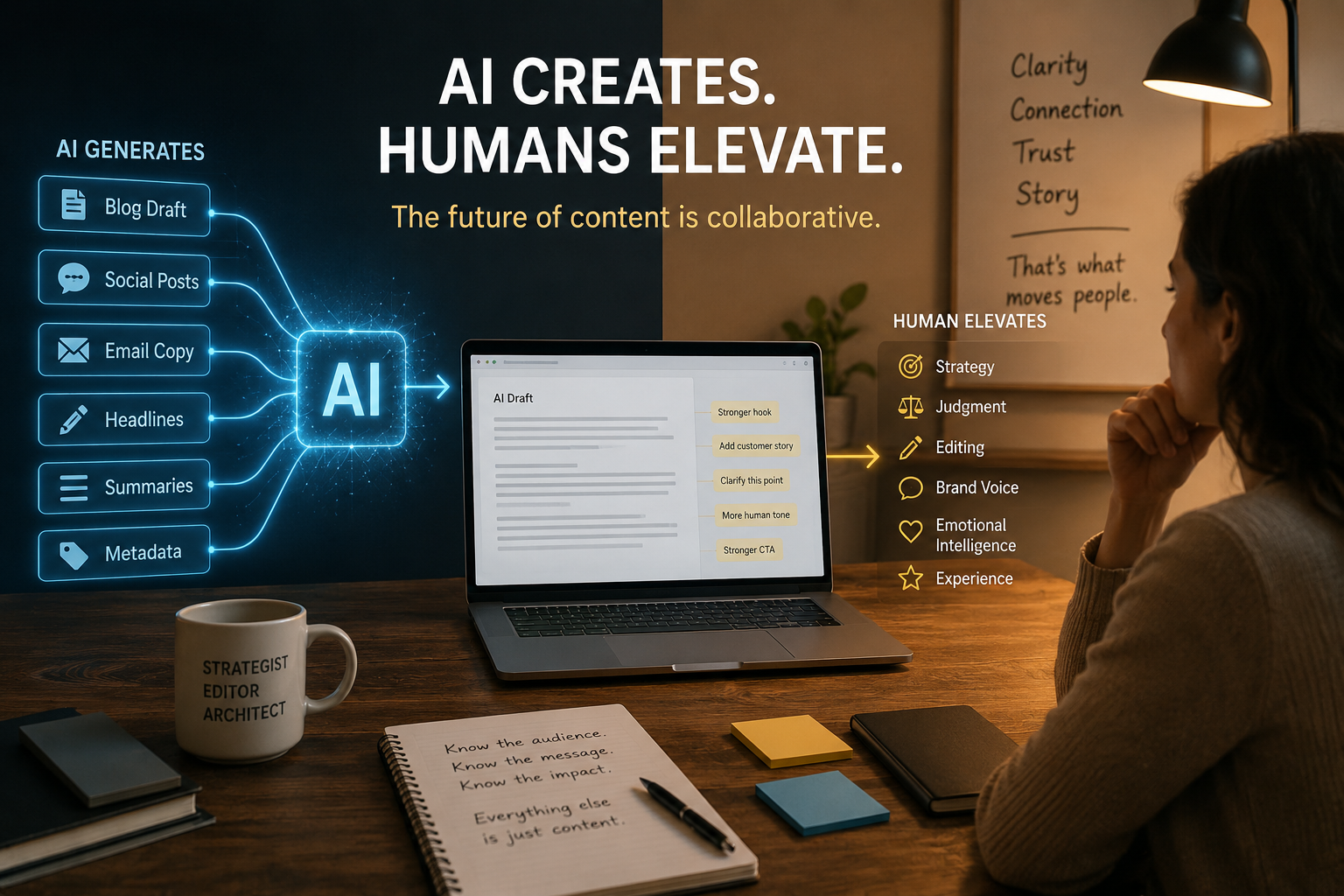
Did I have AI generate this image? You better believe I did!
When ChatGPT first entered the mainstream, I watched two very different reactions unfold.
Some writers panicked. Others declared that content writing was dead.
I never believed either. What I did believe was this: our jobs were about to change.
For years, businesses hired writers to solve one primary problem: they needed someone to create content. Today, AI can generate a blog post in seconds. So where does that leave professional writers?
Not where many people think. What many are surprised to learn is that AI doesn't eliminate writers. It elevates them.
AI Doesn't Solve the Real Problem
Most businesses don't struggle because they can't write. They struggle because they don't know what to say.
Their expertise lives in the heads of founders, executives, sales teams, and customer service representatives. Their messaging exists across scattered documents, years of conversations, outdated websites, and inconsistent marketing materials.
AI can't organize that.
It can't interview leadership.
It can't identify what makes a business truly different.
And it certainly can't build a brand voice from scratch.
Before AI can create exceptional content, someone has to teach it how the business thinks. That's where experienced writers come in.
The Blank Page Is No Longer the Bottleneck
For decades, writing started with a blank page.
Now it starts with a conversation. AI can draft an article, write social posts, summarize research, brainstorm headlines, and repurpose content faster than any human ever could. And honestly, it’s incredible. I feel lucky to be a bystander as this thing evolves.
But speed isn't the same as strategy. The real value has shifted away from generating words and toward directing them. Instead of spending hours writing every sentence from scratch, we spend our time asking better questions:
Is this solving the customer's problem?
Does this sound like the brand?
Is this the right message for this audience?
What story are we really trying to tell?
What should be removed rather than added?
Those questions can't be automated.
The Writer Becomes the Architect
I don't believe the future belongs to people who know how to write prompts.
It belongs to people who know how to build systems.
Imagine walking into a business and creating an AI-powered content engine. You interview leadership. You uncover their philosophy, voice, values, and customer insights. You document the language they use, the objections they hear, and the stories they tell.
Then you build a system that allows AI to consistently produce content that reflects who they are.
Instead of starting from scratch every time someone needs a blog post, newsletter, landing page, or email, the business has a repeatable process.
AI handles the first draft. Humans provide the judgment. That's a completely different service than simply writing articles.
Editing Becomes More Valuable Than Drafting
Some people assume AI will replace editors.
I think the opposite.
As AI produces more content, thoughtful editing becomes even more important. Because editing isn't just correcting grammar. It's recognizing when something feels generic. It's knowing when a sentence doesn't sound like the brand. It's identifying the missing story that transforms a good article into one people actually remember. It's having the confidence to delete half the page because clarity matters more than word count.
AI generates. Editors decide.
And that distinction is everything in content marketing.
The Most Valuable Skill Isn't Writing
It's judgment.
AI can generate ten headlines.
A strategist knows which one will connect.
AI can write an entire webpage.
A communicator knows whether it actually persuades.
AI can summarize information.
A marketer knows what information deserves to be emphasized in the first place.
That kind of judgment comes from years of listening to customers, understanding businesses, studying messaging, and learning what moves people to action. No software downloads that experience overnight.
The Opportunity Ahead
I don't think businesses are looking for someone who simply "uses AI." They're looking for someone who can help them make sense of it. Someone who can build workflows that save time without sacrificing quality. Someone who can train AI to sound like their company instead of sounding like...AI. Someone who can review every piece of content before it reaches customers.
In other words, they're looking for someone who combines technology with human insight.
That's a different role than the traditional content writer. It's also a more valuable one.
We're Not Being Replaced. We're Being Repositioned.
The future of content isn't humans versus AI. It's humans who understand communication working alongside AI that understands speed.
The writer of tomorrow won't simply create content. They'll build content systems. They'll define brand voices. They'll design workflows. They'll teach AI how to think like the businesses they serve.
And perhaps most importantly, they'll provide the one thing technology still can't replicate:
Human judgment.
That's not the end of content writing. I believe it's the beginning of something far more interesting.